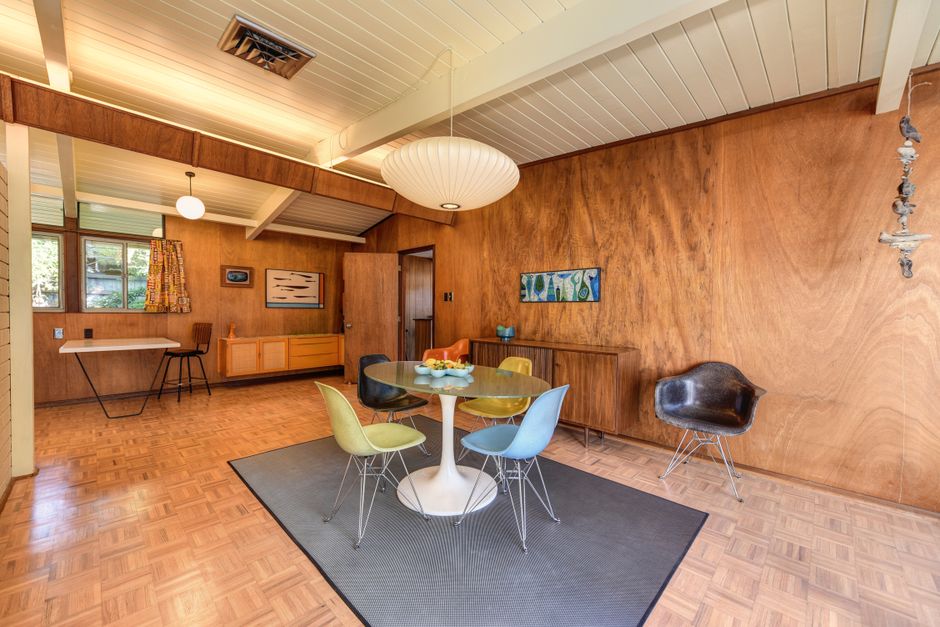
A mid century modern pendant light over a dining table should have a shade about half the table's width, hang with its bottom 30 to 34 inches above the tabletop, and be a saucer or dome shape in brass if the house is warm-toned, and it took me three fixtures and one patient phone call to learn that. The dining room pendant is the one fixture in a mid-century house that everyone sees: it hangs over the table where people actually sit, it's the last thing you look at before you leave for dinner and the first thing guests notice when they walk in. The first one I ordered was 22 inches over a 36-inch table and made the table look small; the second was a 12-inch drum that disappeared over 84 inches of walnut. This post is the rule I wish I'd known, the 18-inch saucer that finally worked and what it cost, the shapes that suit mid-century dining rooms and the ones that don't, the materials and why brass, the hanging height and the friend who looked like she was being crowned, the adjustable cord, what the canyon light does to a brass dome through the day, the dimmer, the bulb, the return trips, the ceiling box and the canopy, sizing for a long table, the pendant and the credenza, what guests notice, the mistakes, and the number.
The First Pendant
It looked perfect on the website: a globe shape, matte black exterior, brass interior that would catch the 2700K bulb I always run. It arrived in a very large box, which should have been the clue. I hung it. The shade was 22 inches in diameter and our dining table is 36 inches wide, and the fixture made the table look small, like a hat on a child. Not the effect I was going for, and it went back within the week with a return label and a lesson I hadn't articulated yet.
The Second Pendant
I overcompensated and went too small: a 12-inch drum shade, fine in concept, that disappeared over a walnut table that runs 84 inches long. The light pool was too tight, lighting the middle four place settings and leaving the ends in the dark, and from the doorway the pendant read as an afterthought. Wrong again, and back in its box. Two returns, two months, and a dining table lit by a floor lamp dragged in from the den.
The Rule I Wish I'd Known First
After the second return, I called Marcus, who does most of our lighting work on the house, and he gave me the rule in one breath: for a pendant over a dining table, the shade diameter should be roughly half the table width, and the bottom of the shade should hang 30 to 34 inches above the tabletop. Our table is 36 inches wide, which points to an 18-inch shade. I'd gone 22, too wide, and 12, too narrow, before landing on 18, which is the number the rule would have given me on day one for the price of a phone call.
The One That Worked
The 18-inch saucer pendant I ended up with is from BO-HA, a low-profile brass dome with a flat diffuser that throws light down and outward at the same time. It doesn't block sightlines across the table, which matters when four people are trying to have a conversation, and it lights all six place settings on an 84-inch table because the diffuser spreads the pool. At $279 it's the kind of fixture that looks like it cost twice that, which I always appreciate, and it's been up for two years without a thought.
Shapes That Work in a Mid-Century Dining Room
After three fixtures, here's what I've landed on for mid-century dining rooms specifically. Saucer and dome shapes work best: they have the low horizontal line that suits post-and-beam architecture, they distribute light evenly, and they don't read as fussy. Globe shapes can work if the room is taller and the table is wider, but they're unforgiving if the scale is off, which my first one proved. Cone shades are period-correct but direct all the light downward, which can make the table feel like an interrogation room unless you have fill light from elsewhere, and the layering post is that fill light.
Shapes That Don't
Anything with visible Edison bulbs, unless you're going for a specific retro register that the rest of your house supports, and ours doesn't. Woven shades, which are having a moment and will date, and which read as coastal rather than canyon. Multi-arm sputniks over a dining table, which are lovely in an entry and a scalp hazard over a chair; the sputnik post is where ours went. Anything with a drum in fabric, which is a hotel lobby. The dining pendant should be one clean shape, and the shape should be low.
Materials, and Why Brass
Brass is the obvious choice for a warm canyon house and it ages well against walnut and teak; ours is unlacquered and it's darkening at the canopy where hands adjust the cord, which suits the room. Black steel reads more industrial than mid-century to me, and it was the mistake of the first pendant's exterior. Copper is warm and a little too much of a statement over a table. White enamel is period-correct and reads cold against walnut. The warm metals post is the argument in full; the short version is that brass is the metal the house was built for.
The Hanging Height
Marcus's 30-to-34-inch rule is a starting point. In our room, with 9-foot ceilings, I ended up at 32 inches from table to shade bottom, which keeps it below eye level when seated but high enough that no one gets a faceful of brass when they lean across to reach the salt. The canopy is on an adjustable cord so I can move it, and I actually raised it by two inches after the first dinner party because our friend Elena, who is 5'11", sat at the head of the table and looked vaguely like she was waiting for someone to crown her. Small adjustment. It matters.
The Adjustable Cord
Buy the pendant with an adjustable cord or a canopy that lets you set the drop, because the right height is decided at the table with people sitting at it, not in the box. Ours has a cord lock in the canopy and 6 feet of cloth cord, and it's been moved three times: down for the first hang, up two inches for Elena, and up another inch when we swapped the dining chairs for taller ones. A fixed-length pendant is a pendant you've decided the height of before you know it.
What the Canyon Light Does to a Pendant
One thing I didn't anticipate: the way the late afternoon light comes through the clerestory windows in this house changes how the pendant reads throughout the day. At 4 p.m. in summer, the brass dome glows gold even before you've switched it on, catching the horizontal California light; by 7 p.m., when you actually need it, the whole table is in warm brass light from above. Choosing a mid-century pendant for a room like this is choosing something that interacts with the natural light all day and becomes part of it, which the clerestory post is about, and it's worth getting right even if it takes three tries.
The Dimmer
Every light in this house is on a dimmer and the pendant is no exception: dimmed low over a dinner table, the brass goes from functional to atmospheric, and at 30 percent with the candles it's the golden-hour glow the dimmer post is named for. At full it's the light for a jigsaw or a tax return. A pendant without a dimmer has one job; ours has three, and the wall dimmer was $28.
The Bulb
One 2700K LED, 800 lumens, dimmable, with a frosted finish because the flat diffuser shows the bulb's shape if it's clear; 2700K because it's the only bulb I buy, and because brass under anything cooler goes green. The warm bulbs post is the whole house's rule; the pendant is where it's most visible, because the bulb is 32 inches from every face at the table.
The Ceiling Box and the Canopy
Post-and-beam ceilings put the box where the beams allow, and ours was 4 inches off the table's centre; the fix was to move the table, not the box, because moving a box in a tongue-and-groove ceiling is a project. The canopy is a 5-inch brass disc that covers the box and the cord lock, and a bigger canopy hides a bigger sin. If the box is more than 6 inches off, a swag hook and a cord to the right spot is the honest answer, and the dining table pendant post covers that case.
Sizing for a Long Table
The half-the-width rule sizes the shade to the table's width; the table's length decides whether one pendant is enough. At 84 inches, one 18-inch saucer with a wide diffuser covers six settings; at 96 or more, two pendants spaced a third of the way in from each end, or one linear fixture, and the two-pendant version is the mid-century answer. Ours is at the edge of one, and the diffuser is why one works.
The Pendant and the Credenza
The walnut credenza on the dining room's long wall has a pair of small brass lamps on it, and they're the fill light that keeps the pendant from being the only source; a dining room lit by one pendant is a table in a dark room. The credenza post is the lamps; the pendant is the table's light, and the two are on separate dimmers so the table can be brighter than the walls.
What Guests Notice
The pendant, first, from the doorway, and the brass glow at 4 p.m. if they arrive early. Nobody has noticed the two returns, and nobody has said the pendant is the wrong size, which after two that were is the review. Elena has forgiven me, and she sits at the side now.
The Pendant at Five O'Clock
Everything on this blog is the house lit the way it really looks at five o'clock, and the pendant at five is off, catching the last horizontal light through the clerestory on its brass rim while the table below is in the soft grey of the canyon's early dusk; at six the dimmer comes up to 40 and the brass takes over from the sun. It's the handover I'd choose the fixture for again, and the reason a matte black exterior was wrong before it was too big: black doesn't catch the five o'clock light, and brass does.
What a Vintage Pendant Would Have Cost
A real 1960s brass saucer from the thrift circuit runs $400 to $900 rewired, and I looked, per the thrifting post; the ones I found were 16 inches or 24, never 18, and one had a canopy that didn't cover our box. A new fixture in the right size at $279 beat a vintage one in the wrong size at twice the price, which is the rare case in this house where new won, and the mixing post is the rule for when it does.
Mistakes
Ordering by photograph twice. Not calling Marcus first. Hanging the first one before measuring the table. Hanging the third at 30 inches and crowning a guest. And the black steel exterior on the first pendant, which taught me the house's metal is brass before it taught me anything about size.
The Number
The saucer pendant, $279. The dimmer, $28. The bulb, $8. Two return shipping labels, $0 and $14. About $330 for the fixture everyone sees, and $293 of it was the one that stayed. Three tries, one rule, and a brass dome that glows before it's switched on.
Shop the pendant: pendant lights and glass pendants in low mid-century shapes