A sputnik chandelier is the most mid-century light there is, and it only works when it has room around it: enough ceiling height that the lowest arm tips clear heads by a wide margin, enough floor that nobody sits directly under it, and a dimmer, because twenty-odd bare bulbs at full power are a lot of light. I learned that the slow way. I bought a 22-arm brass sputnik, 26 inches across, for the dining room of our 1961 canyon house, hung it over the table, and moved it to the entry five weeks later. It has hung just inside the front door ever since, and it is the first thing everyone mentions. This is the whole story: why a sputnik over a dining table did not work for us, why the entry does, sizing for your ceiling, the installation nobody warns you about, bulbs and dimming, the box, and how to tell a good sputnik light fixture from a cheap one.
What a Sputnik Chandelier Is
The sputnik is a ball with arms: a central sphere with straight rods radiating out in every direction, each ending in a bulb. It was designed in the late 1950s, in the space-race years, and the name came from the Soviet satellite. In a mid-century house it reads as exactly the period, in the way a sunburst mirror or a tulip table does. In the wrong house, or the wrong size, it can look like a costume. The difference is almost always scale and placement.
Why It Did Not Work Over Our Dining Table
Our dining table is 36 inches wide and 84 inches long, under a 9-foot ceiling. A 26-inch sputnik is wider than its body because of the arms, and the lowest arms point down and out. To get the bulbs to a sensible height over the table, the bottom arm tips hung about 30 inches above the tabletop, which put them within easy reach of anyone standing up from a chair at the ends. Two people bumped it in the first week. And the light, from 22 exposed bulbs at eye level when seated, was glare, not glow.
Raising it fixed the bumping and made it look like it was floating near the ceiling, disconnected from the table. A sputnik over a dining table can work in a room with a higher ceiling and a wider table, where it can hang high and still look anchored. In ours it could not. The dining table now has an 18-inch brass saucer pendant, and the full story of that choice is in our mid-century modern pendant light post. Our friend Elena, who is 5'11", was the one who said the sputnik looked like a trap over the head of the table, and she was right.
Why the Entry Works
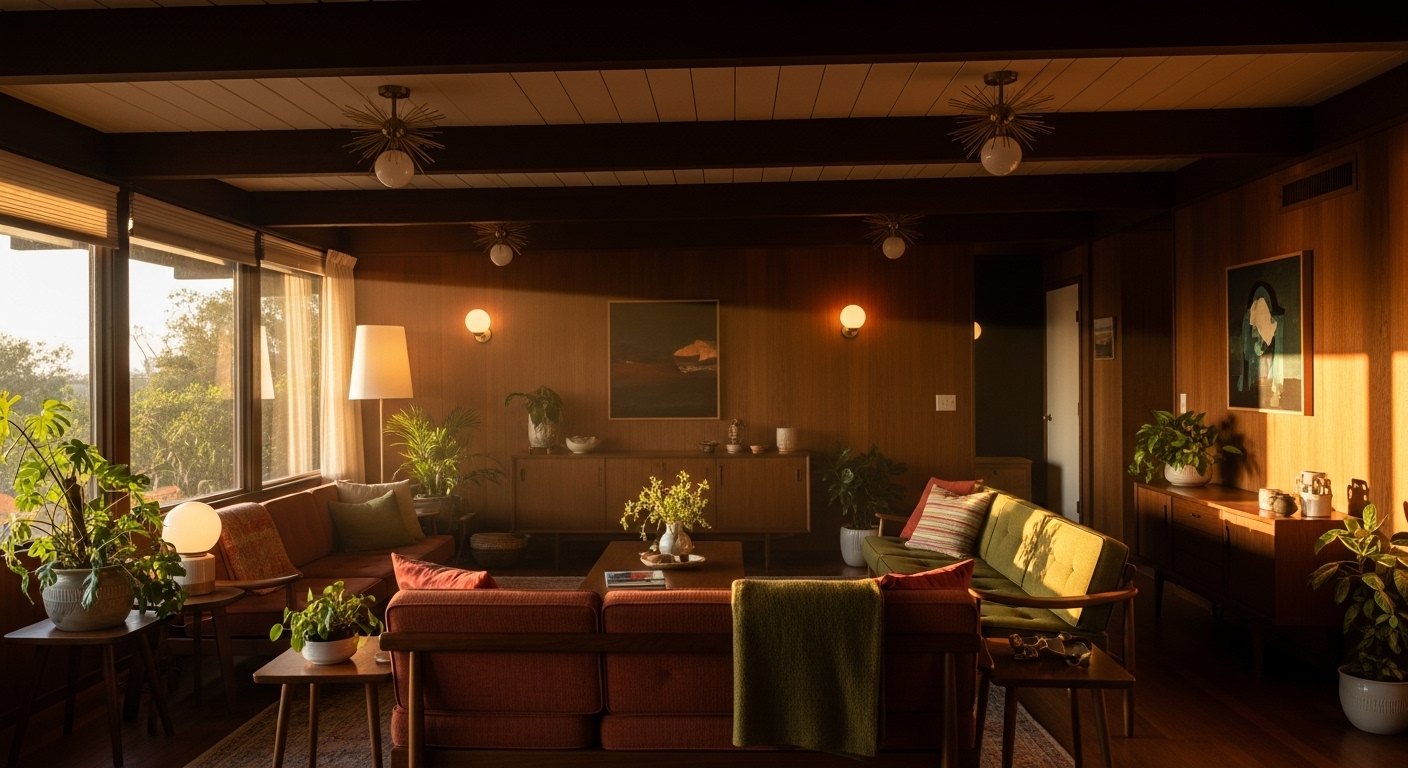
The entry inside our front door is about 8 by 10 feet, with the post-and-beam ceiling rising from 9 feet at the door to about 11 feet at the ridge. Nobody sits there. People walk through and look up. The sputnik hangs from the high side, its lowest arm tips about 7 feet 6 inches from the floor, which clears even tall guests comfortably. From the front door, it is silhouetted against the clerestory windows by day and glowing against the dark wood ceiling at night.
That is what a sputnik wants: space to be seen all the way around, from below and from a distance. Entries, stairwells, living rooms with high ceilings and open-plan rooms with a vaulted section all suit it. Rooms where you sit directly under it for an hour usually do not.
Sizing a Sputnik for Your Ceiling
The sputnik's overall diameter includes the arms, so it takes up more space than its central sphere suggests. My rules after this experience:
8-foot ceilings: choose a small sputnik, under 20 inches, with arms angled upward rather than out and down, mounted close to the ceiling. Or choose a semi-flush sputnik made for low ceilings. Never over a walkway.
9-foot ceilings: up to about 24 inches, with the lowest arm tips at least 7 feet from the floor in a walkway, or 34 inches or more above a table.
10 feet and up: 26 to 36 inches, which is where the sputnik really comes into its own.
For width, the usual room formula works: add the room's length and width in feet, and use that number in inches. Our 8 by 10 entry gives 18, but the 11-foot ridge earns extra size, and the open arms make a sputnik look lighter than a solid fixture of the same width, so 26 inches sits comfortably.
The Installation Nobody Mentions
Sputnik arms usually ship separately and thread into the central sphere by hand. On a 22-arm fixture, that is 22 arms, each taking three or four full turns to seat. The instructions suggested 45 minutes. It took Marcus, who does most of the electrical work on our house, and me about three hours, including testing.
Two details made the difference. First, test each arm as you go. The arms are wired in parallel inside the sphere, and a loose connection in one arm is much easier to find before the next 21 are in. Second, check symmetry pair by pair. The arms come out of the sphere in opposite pairs, and if one side is threaded tighter, that pair tilts off axis. We unthreaded and re-threaded four arms before the whole fixture looked even from below.
Hang the fixture on its chain or rod before you thread the arms, at a comfortable working height if possible, and raise it to its final position afterwards. Threading arms over your head on a ladder is miserable.
The Box and the Weight
Our sputnik weighs 18 pounds. The ceiling box in the entry was already a fan-rated box, rated for 50 pounds, so no upgrade was needed. In the dining room it had been a standard box, and Marcus added a brace before we hung it there the first time. Check before you buy. In a post-and-beam house, the beams may be exposed and the ceiling may be tongue-and-groove planks, so running a new box can mean coming down from the roof side. Know where your box is and what it can carry.
Bulbs and Dimming
Most sputniks use small candelabra-base bulbs. I use clear globe-shaped LEDs at 2700K, about 200 lumens each, which across 22 arms is around 4,400 lumens at full. That is a lot, which is why a dimmer is essential. Ours lives at about 30 percent in the evening, where the bulbs read as points of warm light rather than a glare, and at full only for cleaning the floor.
Clear bulbs are the right choice for a sputnik. The exposed bulb is the design. Frosted bulbs make the fixture look like a bunch of cotton balls. I tried amber-tinted globes for a winter, which pushed the light into caramel. They are lovely in December and slightly heavy in June, so I switch them by season. Make sure every bulb is dimmable and from the same batch, or you will see small differences in colour across the arms.
Brass, Black or Chrome?
Brass is the classic finish and it suits our house, with walnut and teak everywhere. It also ages: the brass on ours has darkened slightly where hands touched it during installation. Black works in a more graphic, modern room. Chrome reads more 1970s than 1960s. Whatever you choose, match it to at least one other metal in the room. Our entry has a brass door pull, so brass it was. Our thinking on warm metals is in brass and copper in a mid-century house.
How to Tell a Good Sputnik From a Cheap One
Solid arms. Good ones are solid metal rods. Cheap ones are thin tubes that bend if you look at them.
Threaded connections. Arms should thread firmly into the sphere, not push-fit.
Even finish. Brass plating on cheap fixtures is often uneven at the joints. Look at close-up photos of the sphere.
Weight. A 26-inch sputnik that weighs 6 pounds is mostly air and paint. Ours at 18 pounds feels like an object.
Socket rating. Each socket should list a maximum wattage that comfortably covers the LED you plan to use.
Sputnik Light Fixture Variations
Classic sputnik. Straight arms radiating in every direction from a central sphere, each ending in a bare bulb. The original and still the most recognisable. Ours is this style.
Starburst. Thinner arms, sometimes with small spikes or discs at the tips instead of bulbs on every arm. Lighter-looking, more decorative, and closer to the sunburst mirrors of the period.
Globe-tipped sputnik. Each arm ends in a small frosted or opal glass globe instead of a bare bulb. Much softer light, less glare, and a good choice where people sit nearby, such as over a dining table in a taller room.
Semi-flush sputnik. A half-sphere against the ceiling with arms pointing down and out. Made for 8-foot ceilings and the best way to get the look in a low room.
Linear sputnik. A horizontal bar with arms along its length, designed for long dining tables. It keeps the period language while fitting a rectangle better than a ball does. If I ever try a sputnik over our table again, this is the version I would choose.
Where Else a Sputnik Works
Stairwells. A tall, open stairwell is perhaps the best place of all: people see it from below, from the landing and from above, and nobody sits under it.
Living rooms with high or vaulted ceilings. Hung over the middle of the room rather than over the sofa, it becomes a centrepiece, and the lamps around the edges do the reading light.
Bedrooms. Only with a high ceiling and only on a dimmer. A sputnik over a bed is dramatic, and 20 bare bulbs above your pillow at full brightness are not restful. Globe-tipped versions are better here.
Bathrooms. Rarely. Exposed bulbs and humidity do not mix well, and the arms collect dust from hair spray. A damp-rated globe pendant does the job better.
Cleaning 22 Arms
Dust sits on every arm and on the top of every bulb. Every two months, I turn the fixture off, let the bulbs cool, and go around it with a soft microfibre cloth and a step ladder, about fifteen minutes. Once a year, the bulbs come out for a proper wipe and the arms get a gentle polish with a dry cloth; brass does not need chemicals, and anything abrasive will strip the finish. If you have a high ceiling and no tall ladder, check before you buy how you will reach it. A sputnik you cannot clean will look dull within a year.
Vintage or New?
Original 1960s sputniks turn up at estate sales and on resale sites around Los Angeles, and they are lovely. They also usually need rewiring, which on a 20-arm fixture means rewiring every arm, plus new sockets and a new canopy rated for modern boxes. By the time Marcus priced that for one we looked at, the vintage fixture plus rewiring cost more than a good new one. If you love a specific vintage piece, buy it and budget for the rewiring. If you want the look and reliable wiring, a well-made new sputnik is the sensible choice. Ours is new, and after a year the brass has darkened just enough that most people assume it is original.
Six Months, and Then a Year
For the first months in the entry I kept second-guessing it, because a sputnik is a strong piece and a room needs time to settle around it. The doubt ended when people started stopping in the doorway to look up before they said hello. It is unmistakably mid-century without being a costume, because it is in a space big enough for it, at a height that leaves everyone clear, on a dimmer that keeps it a glow rather than a spotlight. It pairs with the sunburst on the wall beyond it, which I wrote about in the sunburst light.
The Short Version
A sputnik chandelier belongs where people walk under it and look at it, not where they sit under it. Size it to your ceiling: under 20 inches for 8 feet, up to 24 for 9 feet, 26 and up for 10 feet and above, with arm tips at least 7 feet from the floor in a walkway. Thread the arms slowly and test as you go. Check the box. Use clear 2700K globes on a dimmer. Choose solid arms and real weight. Ours started over a dining table, moved to the entry, and has been the most talked-about light in the house ever since.
Shop statement light: pendant lights and entryway light fixtures sized for real ceiling heights.