An arc floor lamp belongs in a mid-century room because mid-century furniture sits low, and an arc puts the light over a low sofa instead of beside it. To work, it needs a heavy base, at least 25 pounds for any arm over 40 inches, a shade that sits about 6 inches above seated eye level, a 2700K bulb, and a position where the base is out of the walkway and the shade is over the main seat. Ours is a brushed brass arc with a 52-inch reach, a 38-pound marble base and a white cotton drum shade, in the living room of our 1961 canyon house. I have moved it four times since I bought it, not because it was wrong, but because each season and time of day showed me a better spot. This is what I learned: why arcs suit this era, the base weight problem, where it finally landed, shades, bulbs, sizing an arc to a room, and what to check before you buy.
Why Arc Floor Lamps Belong in Mid-Century Rooms
The arc lamp became popular in the early 1960s for a reason that still holds. Mid-century furniture is low. Our sofa has a seat around 15 inches high and a back around 29 inches. A standard table lamp beside a sofa that low shines straight into your face, because the bulb sits above eye level when you are sitting. An arc lamp brings the light over the furniture and points it down, at reading angle, without needing a side table at all.
The second reason is the ceiling. Canyon and hillside houses from this period often have post-and-beam or vaulted ceilings with no electrical box above the seating area. An arc floor lamp gives you a pendant's position with no electrician, no new box and no holes in the ceiling planks. In a house where every beam is exposed, that matters.
And it looks right. A brass arc over a low walnut room is one of the clearest period silhouettes there is, next to the sunburst and the sputnik, and far easier to live with.
The Base Weight Problem
My first arc lamp had a 12-pound resin base painted to look like travertine. It looked fine in photos. In practice it tipped whenever I tugged the cord, leaned on the arm or walked past too quickly, and once it went over completely. I replaced it after six weeks with the current lamp, which has a 38-pound genuine marble base. It has not moved since.
The physics are simple. The arm is a lever. A 52-inch arm with a shade and bulb on the end puts a lot of turning force on the base, and the only thing fighting it is weight. My rule now: for any arc with a reach over 40 inches, do not trust a base under 25 pounds, and heavier is better. Real marble, granite or cast iron. Not resin, not a hollow steel shell. If the product listing does not state the base weight, assume it is light.
Check the base footprint too. A heavy base about 12 to 15 inches across, round or square, is stable without taking over the floor.
Where It Finally Landed
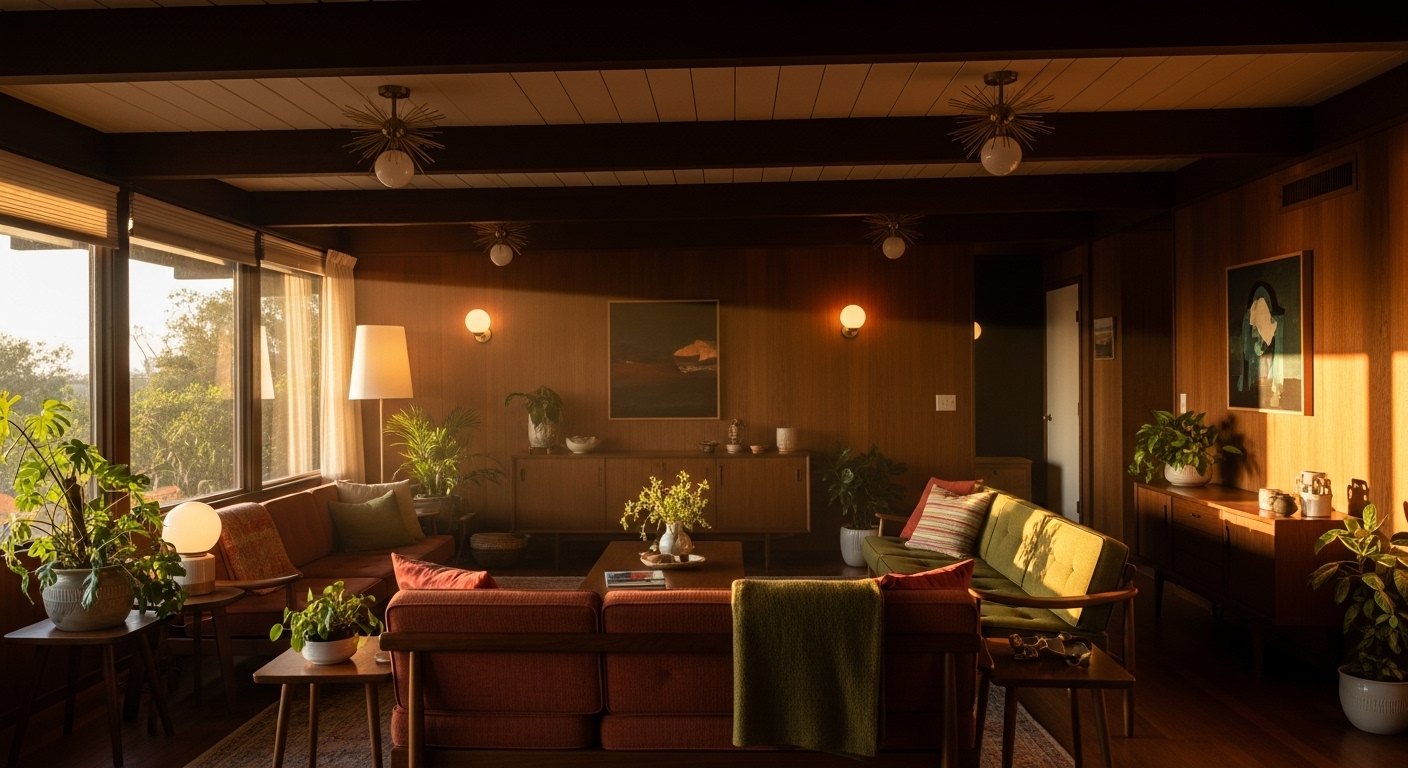
Our living room is about 19 by 14 feet, with original walnut built-ins on the long wall and west-facing windows that turn everything gold around 4 p.m. After four moves, here is the placement that works. The base sits against the wall to the left of the sofa, tucked beside the end of the built-ins. The arm arcs over the right two-thirds of the seating, and the shade hangs centred over the main reading spot, about 6 inches above eye level when seated.
That position does three things. It lights the main seat. It keeps the base out of the path between the sofa and the sliding doors. And it creates a pool of light that stops just short of the coffee table, so the low walnut table sits in soft shadow and looks intentional rather than underlit.
I also angled the shade about 15 degrees toward the wall, so some light washes the walnut built-ins. The bounce off the wood adds warmth to the whole room without making a spotlight on the cushions.
The four moves taught me that the right spot is the one that serves the seat you use most at night, not the one that looks best in the empty room at noon.
How High Should the Shade Hang?
For reading, the shade should hang so its bottom edge is about 6 inches above your eye level when seated, which for most low mid-century sofas means the shade bottom is around 50 to 55 inches from the floor. Lower than that and you see the bulb under the rim. Higher and the light spreads too widely to read by.
For an arc used mainly as ambient light over a coffee table or a conversation area, you can hang it higher, around 60 to 66 inches, so people standing up do not catch it. Our lamp's arm is adjustable at the base, which is worth looking for: it lets you fine-tune the height after you have lived with it.
Sizing an Arc Lamp to the Room
Reach matters more than height. Measure from where the base can sit to the centre of where you want the light. For a sofa against a wall with the base at the end, that is usually 40 to 60 inches. Our 52-inch arm reaches from the wall to just past the middle of a 7-foot sofa.
In a smaller room, under about 12 by 14 feet, a full arc can dominate. A smaller arc with a 30 to 40 inch reach, or a cantilevered floor lamp with a shorter arm, gives the same over-the-seat light with less visual weight. In a large room like ours, a full-size arc fills the space above the sofa that would otherwise feel empty.
The Shade Question
White cotton drum. What we have. It diffuses well and warms the light; a 2700K bulb through white cotton reads as amber rather than white. Good for larger rooms where the lamp needs to fill.
Natural linen. Warmer still, with more texture, and lovely with walnut and teak. In a smaller room it can make the light feel dim.
Spun metal dome. The classic period look in brass or white enamel. Directional, not diffused: the light falls in a cone on the seat and nowhere else. Excellent for a reading chair, less good for lighting a whole room.
I chose white cotton because our room is big and I need the lamp to do some ambient work as well as reading. If I were lighting a reading corner, I would choose a metal dome.
The Bulb
2700K, around 800 lumens, in a frosted A19 shape. A clear filament bulb in an open-bottom drum shows a bright point to anyone sitting on the floor or lying on the sofa. The lamp is on a plug-in dimmer, and on most evenings it sits around 60 percent, which together with the built-in strip lights is all the room needs. Our reasoning for warm bulbs throughout is in warm bulbs, the mid-century secret.
Arc Floor Lamp in an Open Plan
Our living room opens to the dining area. The arc lamp marks the living zone at night the way a rug marks it by day. With the arc on and the dining pendant low, the open plan reads as two rooms. I wrote about layering the whole open space in layering light in an open-plan mid-century house.
What to Check Before You Buy
Base weight stated in the listing, 25 pounds or more for a reach over 40 inches.
Reach measured against your actual sofa and wall.
Adjustable arm or height, so you can fine-tune after it arrives.
Finish that matches another metal in the room. Brass with walnut, black with a more graphic room.
A switch you can reach from the seat, either a foot switch at the base or an inline switch on the cord near the sofa. A switch at the top of the arc is useless.
Cord exit at the back of the base, so the cord runs to the wall instead of across the floor.
Mid-Century Arc Floor Lamp Styles
The classic marble arc. A heavy marble block base, a long stainless or brass arc, and a domed metal shade. This is the period icon, and the shape most people picture. It throws a focused pool of light, which is lovely over a reading seat and less useful as room light.
The drum-shade arc. The same arc with a fabric drum instead of a metal dome. Softer, more diffused light, and easier to live with in a room you use for everything. This is ours.
The multi-head arc. Three or five smaller arcs from one base, each with its own small shade. Sculptural, but the light scatters and the footprint is large. In our room it would have been clutter.
The tripod arc. A curved arm on three splayed legs instead of a weighted block. Lighter to move, but the legs take more floor space and trip people, and it needs a careful balance point.
For a mid-century room, I would choose between the first two. The finish should match the room's warm metal, which in our house is brass, and the base should be a real stone or a weighted metal block.
How an Arc Lamp Changes the Room Through the Day
In the morning, with the west windows still in shade, the arc is off and the room is cool and grey. By 4 p.m. the windows go gold and the lamp is not needed at all; the low sun does what the lamp does, coming across the room at sofa height. At dusk, around 7 in summer and 5 in winter, the lamp comes on at about 40 percent, which carries that same warm, low, sideways light into the evening after the sun has gone. That is what sold me on the arc in this house. It extends the best light of the day instead of replacing it with something harsher from the ceiling.
In winter, when evenings start earlier, the lamp sits at a higher setting and the built-in strips in the walnut shelves come on with it. In summer, it often stays off until 9.
Arc Lamps and Ceiling Height
Our living room has a beamed ceiling that rises toward the ridge, so the arc never feels crowded. In a room with an 8-foot flat ceiling, a full-size arc can look like it is pressing against the ceiling, especially if the top of the curve comes within a foot of it. Measure the lamp's total height and leave at least 12 to 18 inches between the top of the arc and the ceiling. If you cannot, choose a smaller arc or a cantilevered lamp, which reaches out on a straighter arm at a lower height.
Moving an Arc Lamp Safely
A 38-pound marble base is hard to move, which is the point, but it means moving it takes some care. I never lift by the arc; the arm is not designed to carry the base's weight and bends at the joint. Instead, I unscrew the arc from the base where it slots in, move the base on its own, set it down on a folded towel to protect the floor, and then reattach the arc. Felt pads under the base protect the floor and make small adjustments easier, but they also make the lamp easier to tip, so I only use thin ones. On rugs, a heavy base can sink and lean over time; ours sits on the bare floor at the edge of the rug, which keeps it level.
Arc Lamp or Ceiling Pendant?
If you have an electrical box above the seating area and you never plan to rearrange the room, a pendant does the same job with no floor footprint. If you rent, if the ceiling is beams and planks with no box, or if you like to move furniture with the seasons, an arc lamp is the better choice. It also has one advantage a pendant never will: you can move the light to the seat instead of moving the seat to the light. After four moves of my own, I count that as a real feature.
Mistakes I Made
The resin base, which is the big one. Do not save $40 on base weight.
Placing the base in front of the built-ins at first, where it blocked a cabinet door.
A clear filament bulb for the first month, which glared at anyone sitting low.
And centring the shade over the coffee table instead of the main seat. It looked balanced in the empty room and lit nothing anyone was holding.
What I Would Tell Someone Starting Over
Buy the heaviest base you can find. Measure the reach against your sofa before ordering. Hang the shade about 6 inches above seated eye level over the seat you use most. Use a frosted 2700K bulb on a dimmer. Keep the base out of the walkway with the cord running to the wall. And expect to move it at least twice before it finds its home. Ours took four moves, and now it is the light the living room is arranged around.
Shop the rest of the room's light: living room wall lamps and lighting in warm brass.