The back bedroom in this house spent four years as a guest room that nobody used except our cat. When I finally decided to actually work from home properly, instead of from the dining table, I moved the guest bed out and gave myself four weeks to turn the room into something functional. That was my plan. It took three months and two furniture returns.
A mid-century modern home office is harder to get right than it looks in the photos. Here's what I actually learned.
The Desk Problem
My first desk was a mid-century reproduction from a well-known retailer, walnut veneer, tapered legs, very classic. I positioned it against the far wall facing out into the room, which felt right. It wasn't. The room faces east and the morning light comes in hard through the sliding door. Facing away from the window meant I was lit from behind, which made video calls terrible and created a persistent shadow on whatever I was working on. I moved the desk three times before I accepted the real problem: the desk was positioned wrong, not the room.
The solution was to rotate 90 degrees so the window was to my left. Glare during early morning, which I'd been trying to avoid, turned out to be a non-issue with the right blind angle. The original desk actually worked fine once it was placed correctly. I'd spent $1,840 on it and almost returned it because of placement. That felt embarrassing in retrospect.
What Actually Defines a Mid-Century Office
After spending more time than I'd like to admit on this, I'd say a genuinely mid-century modern home office comes down to three things: low horizontal furniture, a warm surface material (walnut or teak, never veneer over MDF if you can help it), and one strong lamp with a sculptural silhouette. That's the skeleton. Everything else is optional.
The arc floor lamp is the piece that reads most immediately as MCM. The geometry of a long arc arm with a pendant shade at the end is so specific to the period that one arc lamp can anchor an entire office. I have an arc lamp behind the chair at a height of 66 inches at the center of the shade — high enough to wash the whole desk without a hot spot, low enough to not get lost near the ceiling. It was the purchase I agonized over longest and the one I'd recommend most confidently.
The Credenza Situation
The second piece I couldn't figure out was a credenza. I wanted one for storage and to lower the visual weight of the room — a tall bookcase would break the horizontal line that makes mid-century furniture feel so settled. I hunted for three months for a vintage piece. Found a teak model from 1964 at an estate sale for $620. It needed refinishing — the top had sun damage and ring marks — which cost another $380 at a local furniture restorer. Total $1,000 for a piece that would cost $2,400 to $3,000 new and have laminate sides instead of solid teak. Worth every bit of it.
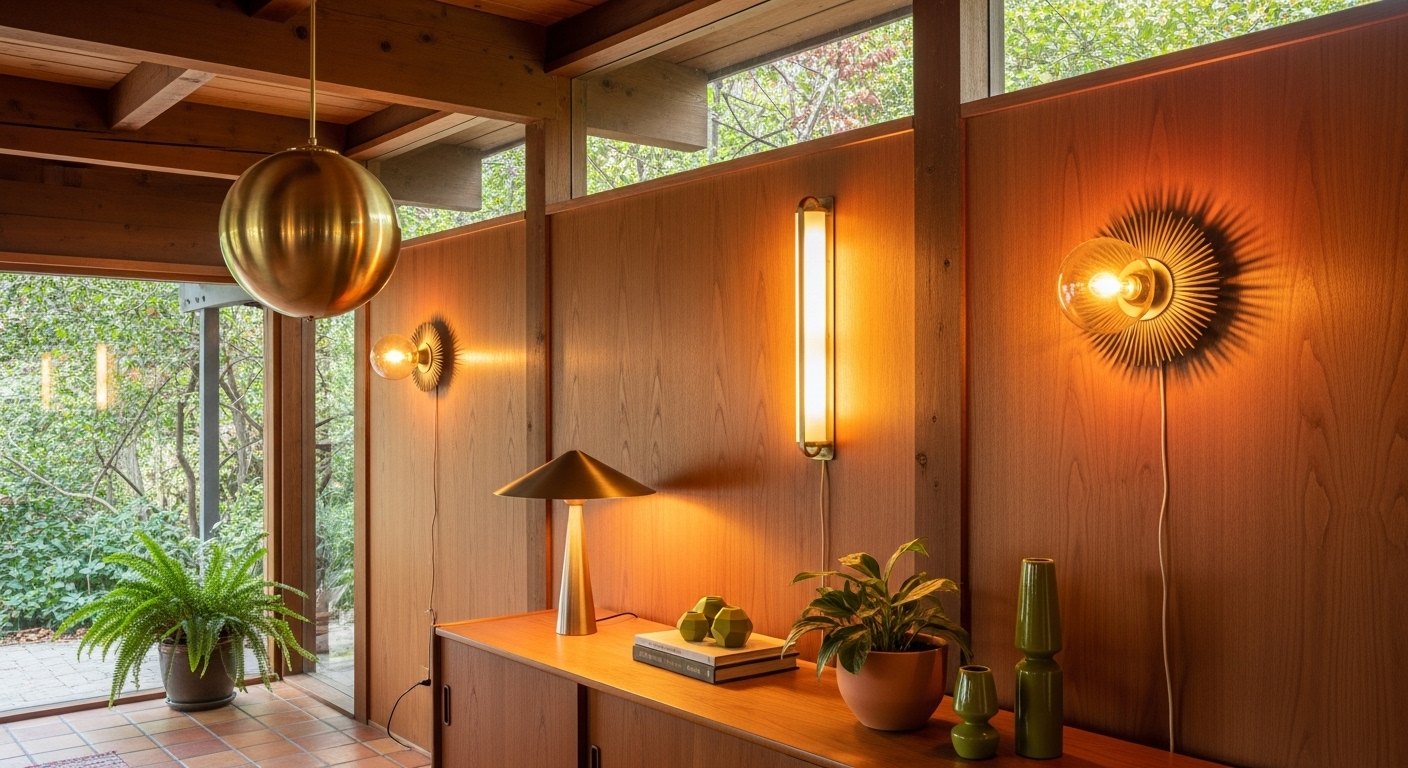
I use the credenza as a secondary work surface for my printer and reference materials, with the upper cabinet hiding everything I don't want to look at. For how the room handles layering light at different levels, the horizontal line of the credenza creates exactly the right visual anchor.
What I'd Tell Someone Starting From Scratch
Get the lamp first. It's the piece most people underestimate and it's the thing that makes the room feel MCM rather than just "wood furniture." A cone desk lamp at the right height, plus an arc floor lamp behind the chair — those two pieces do more for the aesthetic than anything else you could buy.
Second: face the window if you can. Natural light to the side is ideal, natural light behind you is not. Work with the room's orientation rather than against it.
Third: let yourself spend real money on one good vintage piece. The credenza changed the room more than any of the reproductions did. The BO-HA floor lamp collection has several arc options that would work well in a period-appropriate way — I'd look there before reproductions if you want something at a reasonable price with the right silhouette.
The arc floor lamp I use: a black arc arm with an aged brass joint, linen shade. The combination of black and warm brass is period-correct without being precious about it.