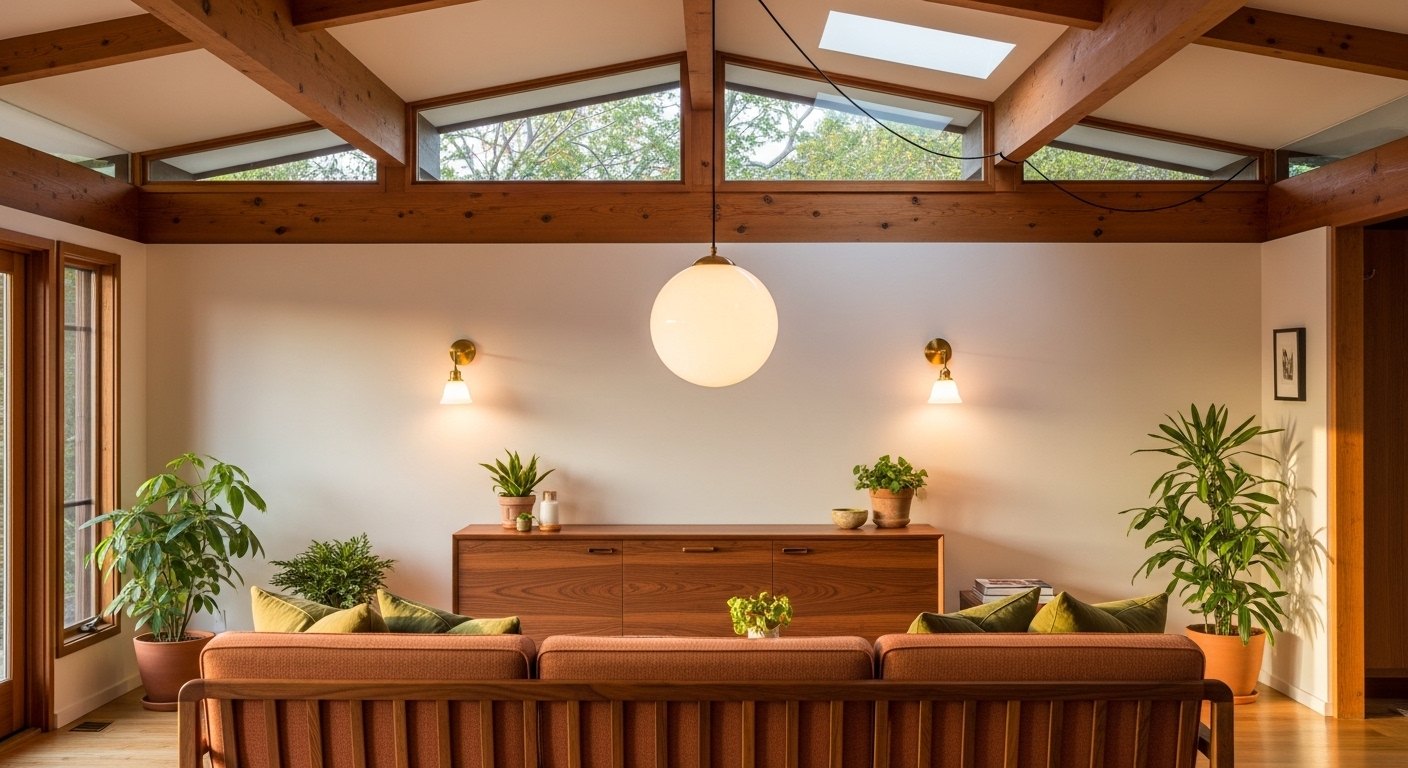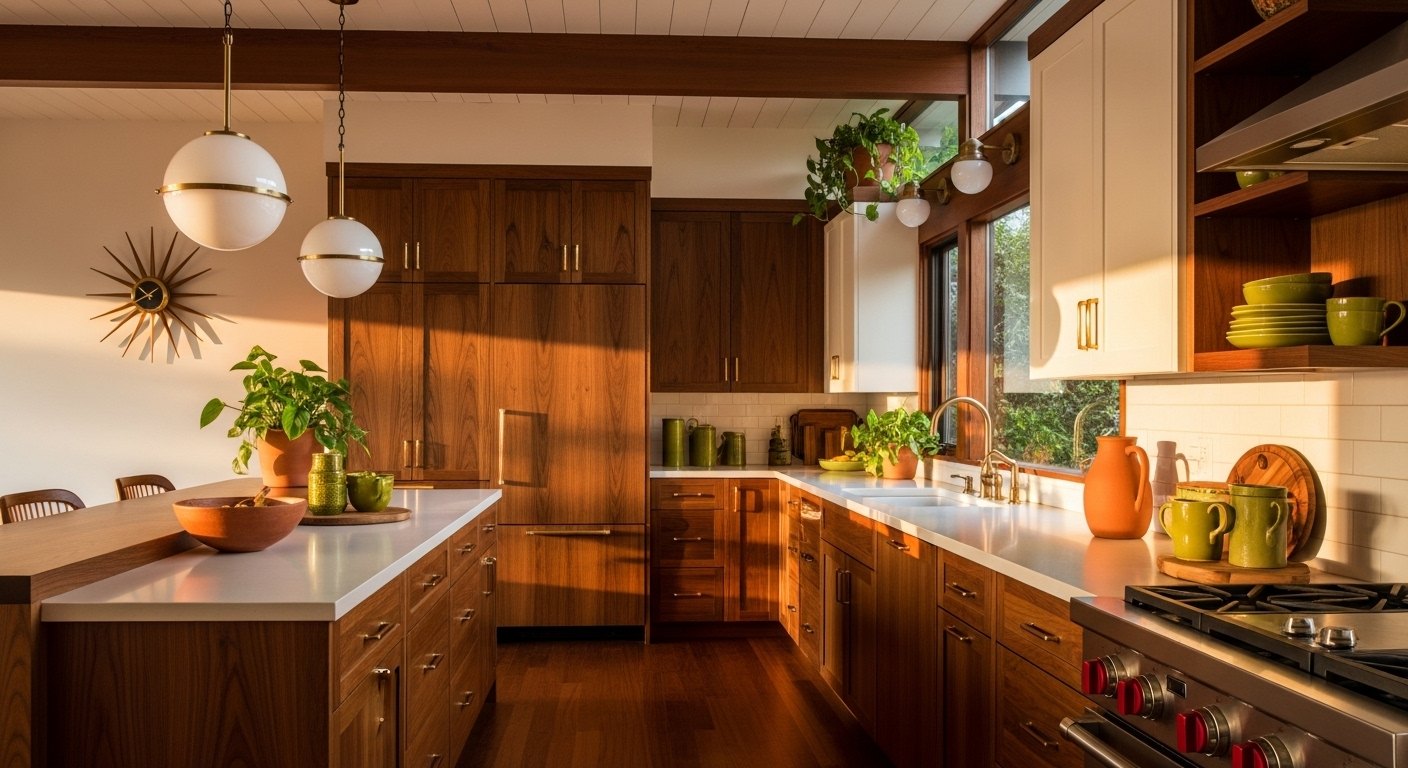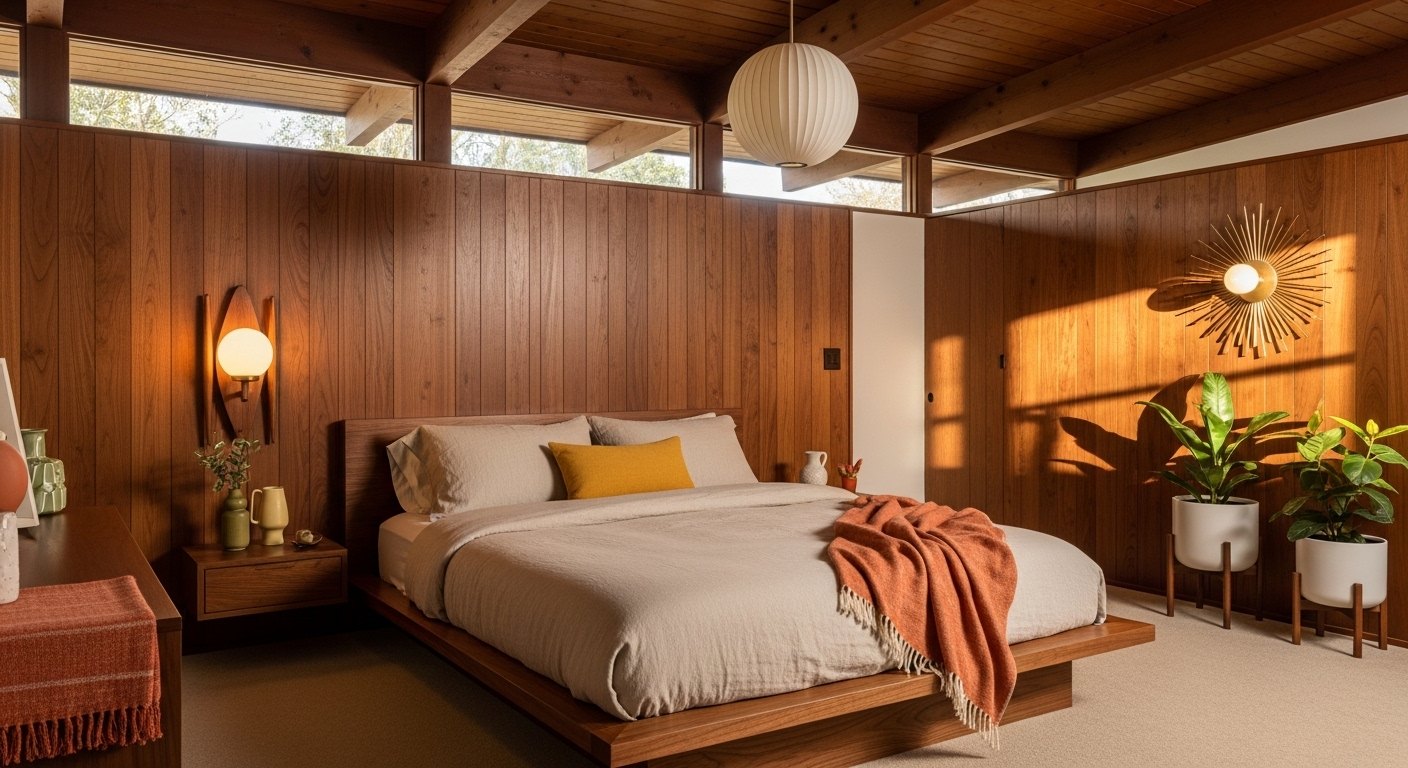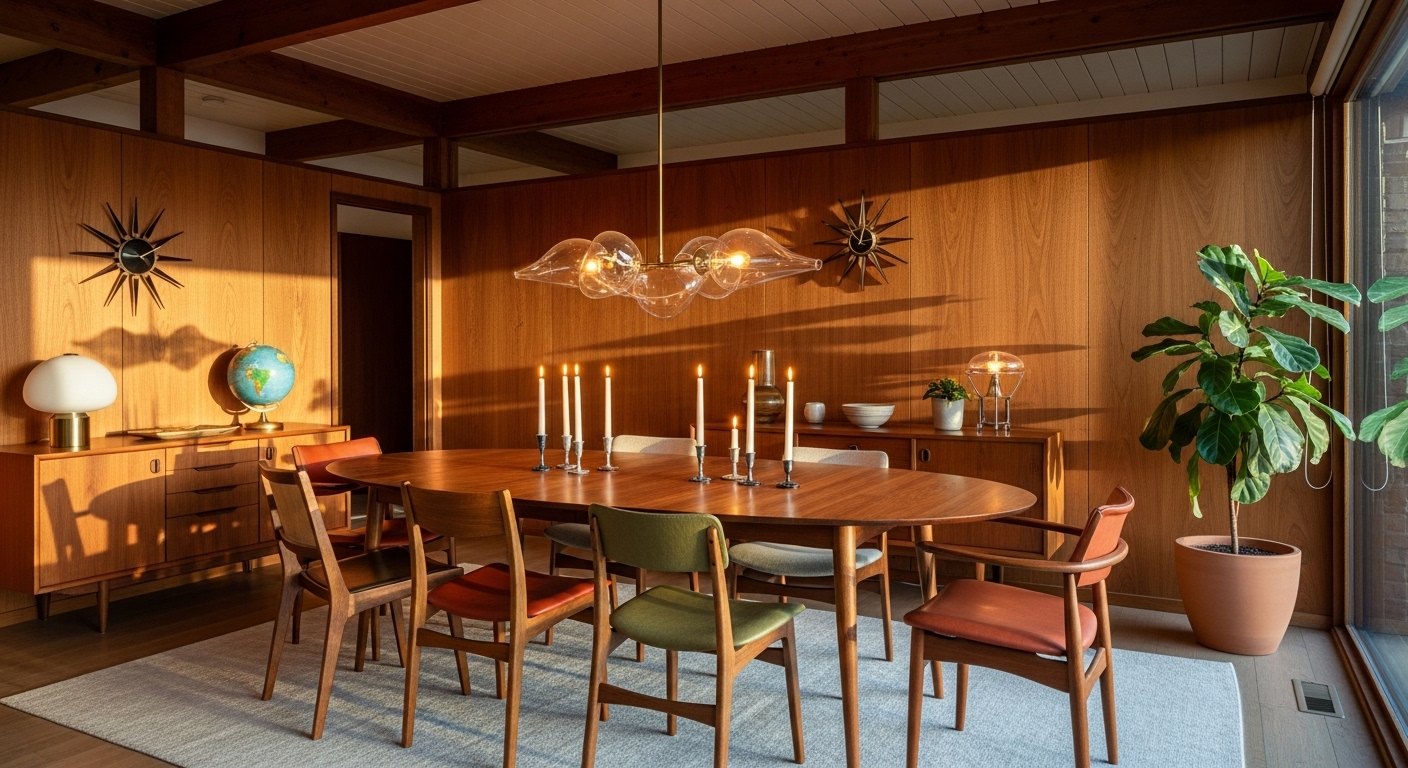
The dining room is where mid-century warmth gets to show off. It's the room where the walnut, the sculptural lighting, and the gathered, lived-in feeling all come together over a long dinner. Ours sits between the kitchen and the windows, catching the last of the canyon light, and we designed it to make a Tuesday dinner feel like an occasion.
The Walnut Table
At the center is a warm walnut table with splayed legs, clean-lined, simple, and unmistakably mid-century. The grain does the decorating, so the table needs nothing else. We chose an oval, which softens the open plan and keeps conversation flowing in a way a hard rectangle doesn't.
Mismatched Modern Chairs
The chairs don't match, and that's deliberate. Two are spindle-backed, two are molded shell chairs, unified by a shared warm wood tone. A perfectly matched set would feel like a showroom; a gathered mix reads collected and real, which is the heart of a lived-in mid-century home. The common wood tone is the thread that keeps the variety from tipping into chaos.
The Sculptural Pendant
Over the table I hung a sculptural glass pendant, the Kalle glass pendant, which brings the era's love of clean geometry and warm glass without tipping into kitsch. A dining pendant is the statement fixture of the room, so I sized it to about two-thirds the table width and centered it over the table, not the room. You can see the range I considered in the dining lighting collection.
Hang It Low
Because no one walks under it, the dining pendant can hang lower than anywhere else in the house, 30 to 34 inches above the table. I settled on 32 after testing. Low pools the light warmly on the table and faces; higher starts to feel like general room lighting and loses the intimacy. That low, contained glow is what makes the room feel special at night.
A Second, Lower Light
One pendant lights the table; a warm room needs a second source. A small lamp on the walnut sideboard adds a low glow at the edge of the room, and for bigger gatherings I'd add a pair of sconces. The principle is the same as everywhere in the house: never let a single overhead source do all the work.
The Dimmer Is Non-Negotiable
If you dim one room in the house, make it the dining room. A bright overhead is for homework and folding laundry; a dimmed one is for lingering over a long meal. Dropping the pendant low in the evening also makes the warm bulb glow even more golden, which is exactly the register a dining room wants after dark.
Candles and a Single Accent
A couple of taper candles, a low ceramic bowl of whatever's in season, and one saturated note, a terracotta runner or a mustard ceramic. With the pendant dimmed and the candles lit, the room does exactly what a warm mid-century dining room should: it makes people want to stay at the table long after the plates are cleared.
What I'd Do Differently
I'd have bought the larger pendant the first time instead of returning an undersized one, and I'd have added the sideboard lamp on day one. The room felt flat until that second, lower light went in. The lesson I keep relearning: the table makes the meal, but the light makes the evening.
Building the Room on a Budget
A collected dining room is the easiest room to do cheaply, because mismatched and thrifted is the look. The sculptural pendant was the one real purchase; the chairs were gathered secondhand and unified by tone, and linen napkins and candles cost almost nothing. The gathered feeling can't be bought in one trip anyway, so patience serves the aesthetic.
Common Dining-Light Mistakes
The big three: a fixture hung too high so it reads as general room light; a fixture too small for the table; and no dimmer. So the only setting is bright-overhead. Hang it 30-34 inches above the table, size it to two-thirds the table width, and put it on a dimmer.
Everyday vs. Gatherings
The room flexes between a quiet Tuesday and a full table. Everyday, the dimmed pendant and a sideboard lamp are plenty; for gatherings I bring up a second source and light the candles so faces glow from more than one direction. The fixtures that look as good dimmed low as bright are the ones a dining room actually needs.
Shop this post: dining room lighting ideas and the Kalle glass pendant