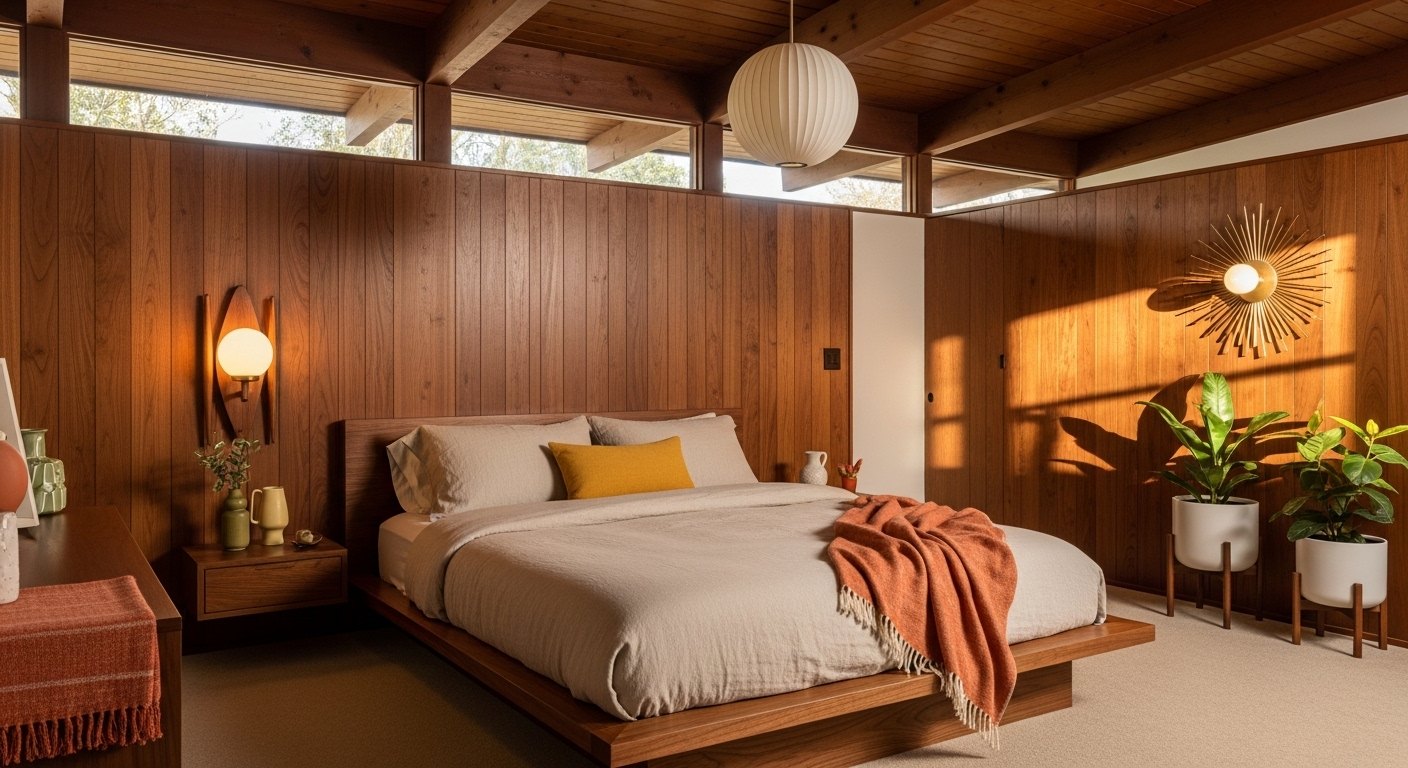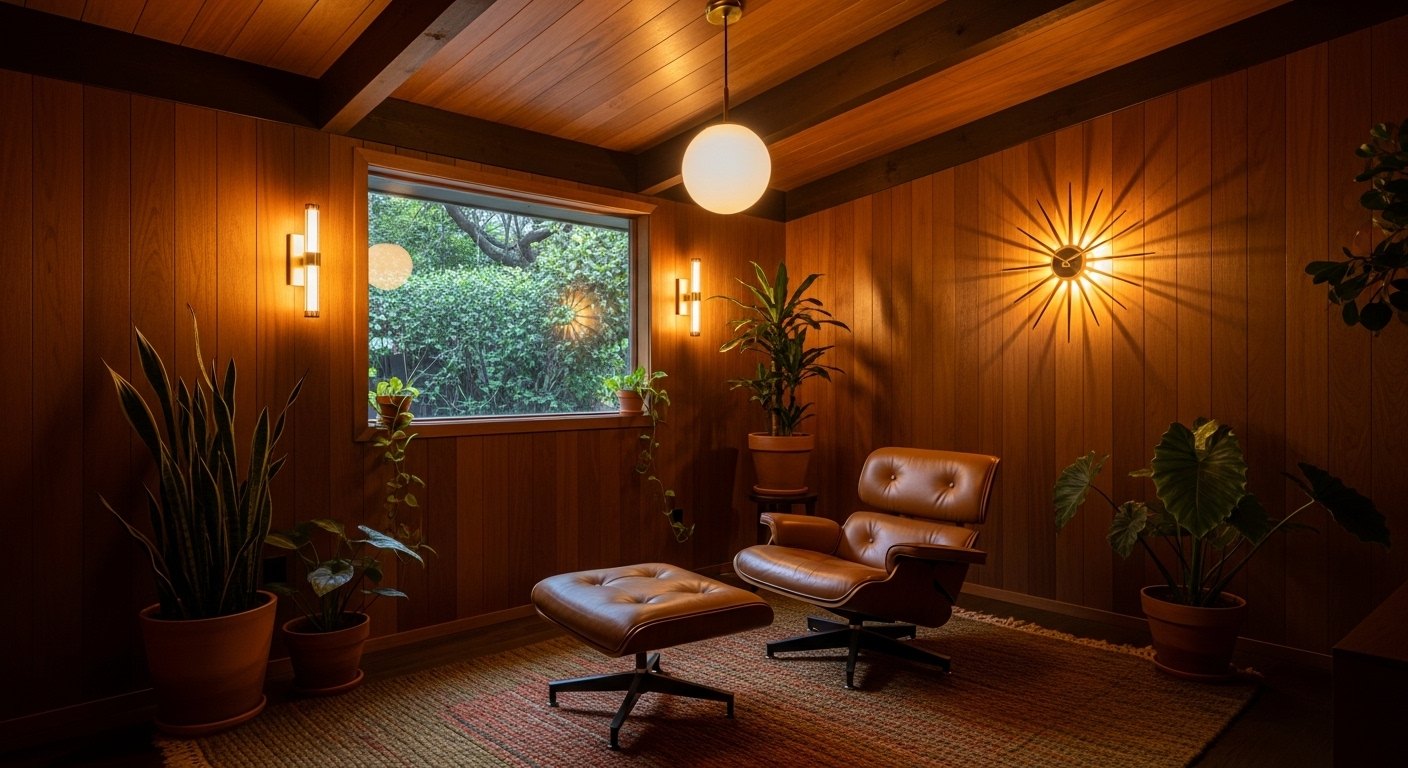
Wood-paneled walls are the most mid-century thing we did, and the most divisive. Done wrong, walnut paneling reads like a 1970s basement; done right, it makes a den the warmest, coziest room in the house. The whole trick is keeping the wood warm and lighting it like the moody retreat it wants to be.
Warm Walnut, Not Orange
The first decision was tone. We chose walnut panels with a warm, slightly cool-brown finish rather than the orange-tinted wood that dates a room instantly. Clean vertical lines keep it architectural. Against that warm wood, everything else in the room stays simple so the paneling can be the statement.
Why Paneling Needs More Light
Wood absorbs light rather than bouncing it, so a paneled room needs more warm sources than a pale one. This is the single most important thing to understand. A den lit by one overhead fixture goes cave-dark and dated. We layered the light at several heights to keep the room warm and dimensional.
Sconces That Graze the Wood
The hero fixtures are a pair of wall sconces, specifically the Gunnar mid-century cigar sconce, whose slim brass arm is pure period charm. Mounted on the paneling, their light grazes the wood and shows off the grain, adding warmth at eye level. Sconces are the most effective lighting in a paneled room precisely because they light the walls, not just the floor.
A Low Leather Chair
The seating is a single low leather lounge chair and ottoman, warm cognac leather that ages beautifully against the walnut. Low, clean, and comfortable, it's the chair I end every day in. A den doesn't need much furniture; it needs the right furniture and the right light.
The Lamp and the Dimmer
A low floor lamp beside the chair handles reading, and a dimmable overhead kept low fills the room softly. Everything is warm 2700K and on dimmers. By day the den reads warm and inviting; at night, dimmed low, it turns genuinely moody. The room you retreat to with a record on.
Keeping It From Going Dark
The risk with a paneled, leather-and-walnut room is that it tips from cozy into gloomy. The fix is purely lighting: enough warm sources at enough heights that the room glows rather than swallows light. A wool rug in a warm neutral and a single brass-and-glass object catching the light keep it feeling rich rather than heavy.
A Personal Layer
The den is where the personal things live, books, records, a few ceramics, a plant that's outgrown its corner. Against the disciplined walnut, those personal objects are what make the room feel like ours rather than a set. The paneling is the architecture; the objects are the life.
What I'd Do Differently
I'd have wired the sconces before the panels went up rather than fishing for them after. And I'd have added a third low light source sooner, even a small picture light on the bookshelf, because a paneled room is hungrier for warm light than you expect. Everything else, I'd panel again tomorrow.
What the Den Cost
Real walnut paneling is a premium material, but warm walnut-veneer panels or a wood-tone treatment get the look for far less. The sconces and a floor lamp were the lighting spend; the leather chair was the splurge. The key cost-saver is that a paneled room needs few furnishings. The walls are the decoration.
Common Paneling Mistakes
Paneled rooms go wrong when the wood reads orange, when the room is lit by one harsh overhead, and when it's cluttered. Choose a warm-but-not-orange finish, layer warm light at several heights so the wood glows instead of going cave-dark, and keep the furnishings simple and low.
How to Light Wood Well
Wood absorbs light, so a paneled room is hungrier for warm sources than you expect. Sconces that graze the wall show off the grain, a floor lamp adds reading light, and a dimmable overhead fills the room. Three warm sources at three heights turn paneling cozy; one overhead turns it into a 1970s basement.
Shop this post: wall sconces and the Gunnar mid-century cigar sconce