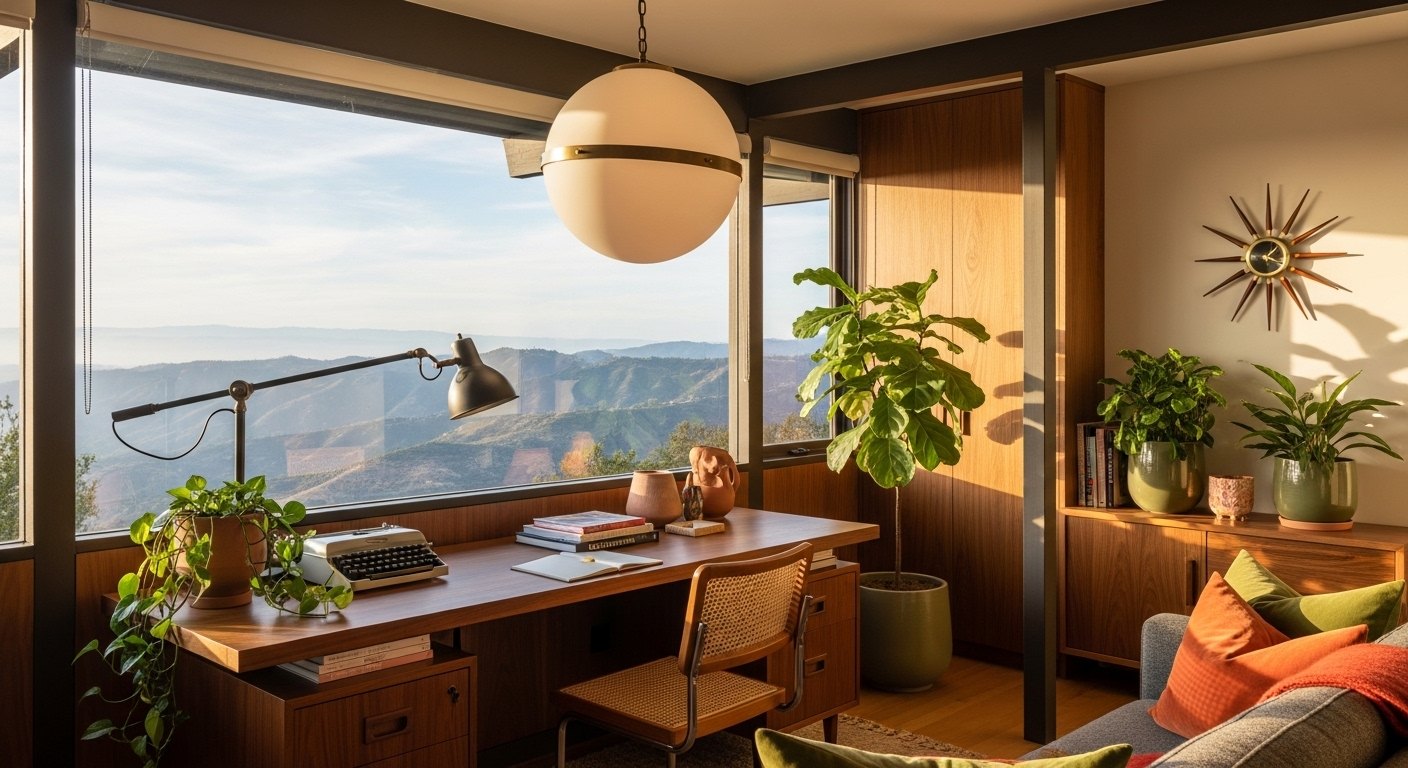
A workspace can be warm and mid-century too. I refused to let the office be the one joyless room in the house. It faces the canyon, and I built it to be as warm and light-filled as anywhere else, proof that a home office doesn't have to feel like a cubicle transplanted into a beautiful house.
The Walnut Desk and the View
The desk is warm walnut with splayed legs, positioned beside the window rather than in front of it so I get the canyon view and the daylight without the screen glare. A window directly behind a monitor backlights the screen and tires the eyes; side light gives you the best of the view and the light without fighting your work.
A Cane-Back Chair
The chair is a cane-back mid-century design, light, comfortable, and a world away from a black ergonomic office chair. The open weave keeps the room feeling airy, and the warm wood frame ties it to the desk. A beautiful chair you actually want to sit in does more for a home office than any gadget.
Ambient Plus Task
Overhead I hung a simple globe pendant for ambient fill, but the real workhorse is an adjustable wall sconce beside the desk that throws focused light onto papers without bouncing off the screen. Ambient light for the room, task light for the work. The two layers together cover everything from a video call to reading a contract without harsh shadows. The Illuminating Engineering Society has good guidance on positioning task light to avoid glare.
Warm or Cool, by the Hour
The office is the one room where I bend the warm-light rule. A slightly cooler bulb around 3500K in the task sconce aids focus during the working day, while the warm pendant on a dimmer keeps early mornings and evenings calm. A tunable smart bulb is the elegant way to let one fixture do both, shifting temperature on a schedule.
Keeping It Warm, Not Sterile
Natural materials are what keep the office from feeling like a workspace: the walnut desk, the cane chair, a woven basket for files, a trailing plant on the shelf. Managing the cords and keeping the desk surface mostly clear does the rest. The same warm mid-century calm as the rest of the house means stepping into work doesn't feel like stepping into a colder world.
A View Worth Facing
The canyon out the side window is the office's best feature, and arranging the desk to catch it, without putting it behind the screen, cost nothing and matters more than any fixture. On a long day, glancing up at the canyon and the changing light is the thing that resets my head.
What I'd Do Differently
I'd have invested in the adjustable task sconce first instead of relying on the pendant alone for the first month. The eye strain on overcast afternoons was real until directional task light went in. And I'd add a tunable bulb to the pendant so I'm not mentally switching gears between a daytime and an evening office.
What the Office Cost
This was a low-cost room built around light and a view. A walnut desk and a cane chair set the tone; a globe pendant and an adjustable task sconce did the lighting; a plant and a basket softened it. The real investment was placement, putting the desk beside the window, which cost nothing and matters more than any fixture.
Mistakes That Cause Eye Strain
Home offices strain eyes with one overhead source and no task light, a window directly behind the monitor, or a bulb so cool the room feels clinical all day. Add a side-positioned task light, put the window to the side, and use a neutral daytime bulb with a warm evening option.
Making Work Feel Like Home
The line between office and cubicle is natural material and warm light. A wood desk, a cane chair, a plant, managed cords, and a warm pendant for the edges of the day soften the function. The same warm mid-century calm as the rest of the house means stepping into work doesn't feel like stepping into a colder world.
Shop this post: modern pendant lighting and modern wall sconces