The entry is the first breath of a mid-century home, and in a California modern house it's often a breezeway, a covered, half-open passage that blurs indoors and out before you ever reach the door. Ours sets the warm, light-filled tone for the whole house, so we treated its lighting as carefully as any interior room.
The Indoor-Outdoor Threshold
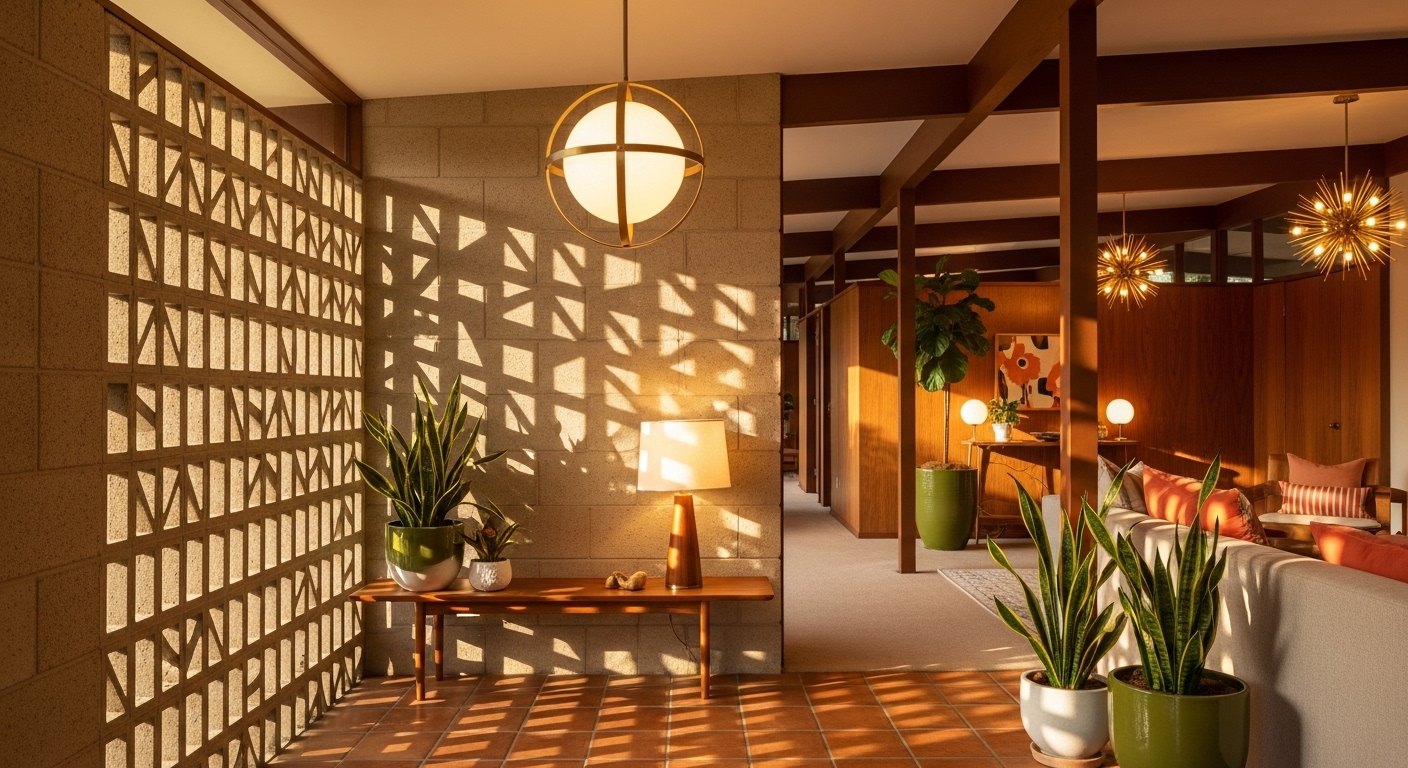
Our breezeway runs along a wall of original screen blocks, the geometric concrete blocks that are a signature of mid-century California architecture. All day they cast shifting graphic shadows across the walkway, filtering the harsh canyon sun into something soft and patterned. It's the kind of architectural feature you light with, not over. The goal is to keep that play of light and shadow going after dark.
A Sculptural Pendant
We hung a sculptural foyer pendant at the entry, a clean globe that draws the eye and glows warmly the moment you arrive. Even in a covered outdoor entry, a pendant gives the space a sense of intention and welcome that a flush ceiling fixture never does. Its warm glow is the first thing that says come in.
A Place to Land
Just inside, a low walnut console gives keys, mail, and sunglasses somewhere to live, with a small lamp on top for a second glow at eye level. A round mirror above it bounces the light deeper into the hall and makes the passage feel wider. You can see the rest of the entry fixtures I weighed. But the console lamp matters as much as the overhead, because eye-level light is what makes an entry feel warm rather than merely lit.
Warm and Dimmable
The pendant is on a dimmer with a warm 2700K bulb. In the evening it glows low and soft; when guests arrive I bring it up. Warm light at a front door reads as welcome; cool light reads like a parking lot. That small flexibility is what makes an entry feel like a living part of the home rather than a passage to somewhere better.
Natural Texture at the Door
A woven basket for shoes, a jute runner, and a stoneware vase I keep filled with clippings from the canyon. These natural touches signal the warm, organic mid-century feeling of the whole house from the very first step inside. Restraint is the point, a calm, uncluttered threshold is more welcoming than a styled one.
Lighting the Screen Blocks
The detail I'm proudest of is a low warm uplight that grazes the screen-block wall at night, throwing those geometric shadows back across the breezeway after the sun is gone. It turns a practical passage into the most atmospheric few feet in the house and keeps the indoor-outdoor magic alive into the evening.
What I'd Do Differently
I waited far too long to replace the original bare bulb that came with the house. It should have been the first fixture I changed, not one of the last, because the entry is the first and last thing anyone sees. I'd also have put the pendant on a dusk-to-dawn smart bulb so it greets us automatically when we come home after a night out in the canyon.
What the Entry Cost
The breezeway came together for very little, the foyer pendant replaced a bare bulb, the console was a thrift find, and a mirror, a small lamp, and a basket rounded it out. For the price of one nice piece of furniture, the first and last thing anyone sees went from dated to welcoming. The best per-dollar return of any space.
Common Entryway Mistakes
Entries go wrong when they have nowhere to put things, so clutter piles up; when the only light is a harsh overhead; and when they're over-decorated. Give every item a home, add a warm dimmable light and a console lamp at eye level, and keep the styling to a mirror, a vase, and a basket.
Lighting the Architecture
If your entry has a feature, screen blocks, a slatted wall, a textured surface, light it. A low warm uplight grazing a textured wall keeps architectural interest alive after dark and turns a practical passage into the most atmospheric few feet in the house. It's a small fixture with an outsized effect.
Shop this post: foyer pendant lights and entryway light fixtures